Monday, 30 September 2013

A cisco packet tracer scenarios

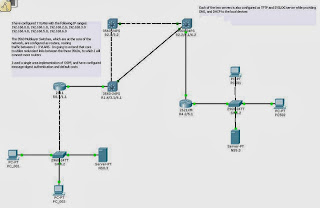
Kawawa Chitiya, in this PT scenario, configured 7 VLANs with the following IP ranges:
192.168.0.0, 192.168.1.0, 192.168.2.0, 192.168.3.0
192.168.4.0, 192.168.5.0, 192.168.6.0

The 3560 Multilayer Switches, that are at the core of the network, are configured as routers, routing traffic between 2 - 3 VLANS. He is going to extend that core to utilize redundant links between the three 3560s, to which he will connect more routers

He used a single area implementation of OSPF, and configured message-digest authentication and default costs.

Each of the two servers is a configured as TFTP and SYSLOG server while providing DNS, and DHCP to the local devices

Loving Cisco! my USB

cisco devices


Starting from the bottom:
2850 Dell Poweredge Server Running Cisco ACS to provide AAA
(2) Cisco 3550 Switches with Inline Power EMI
Cisco 2650XM Router Running CME with a WIC-1T and a WIC-T1 DSU/CSU
Cisco 3640 Router with a NM-4AS used as his Frame Relay Switch
Cisco 3548XL Switch
Cisco 2620XM Router with a WIC-1T
Cisco 2650XM Router Running CME with a WIC-1T (He just bought a WIC-T1 DSU/CSU (the WIC-T1 DSU/CSU's will be connected with a T1 Crossover Cable to provide a failover path in case the Frame Relay Switch goes down)
Cisco 3524XL SwitchCisco 2620XM Router with a WIC-1T and a WIC-1AM-V2
An ADSL Router to provide internet access and to be able to telnet into his Routers and Switches from his mobile phone or a remote computer with Internet Access.

In the upcoming months he will be adding the following:
4 Cisco VoIP Phones.
(2) Cisco 3750 POE Switches
(4) Cisco 2801 or 2811 Routers
And Finally a very much needed 40U Rack


Access Server

WAN Switch

WAN Devices

WANs use numerous types of devices that are specific to WAN environments. WAN switches, access servers, modems, CSU/DSUs, and ISDN terminal adapters are discussed in the following sections. Other devices found in WAN environments that are exclusive to WAN implementations include routers, ATM switches, and multiplexers.

WAN Dialup Services

Dialup services offer cost-effective methods for connectivity across WANs. Two popular dialup implementations are dial-on-demand routing (DDR) and dial backup.
DDR is a technique whereby a router can dynamically initiate and close a circuit-switched session as transmitting end station demand. A router is configured to consider certain traffic interesting (such as traffic from a particular protocol) and other traffic uninteresting. When the router receives interesting traffic destined for a remote network, a circuit is established and the traffic is transmitted normally. If the router receives uninteresting traffic and a circuit is already established, that traffic also is transmitted normally. The router maintains an idle timer that is reset only when interesting traffic is received. If the router receives no interesting traffic before the idle timer expires, however, the circuit is terminated. Likewise, if uninteresting traffic is received and no circuit exists, the router drops the traffic. Upon receiving interesting traffic, the router initiates a new circuit. DDR can be used to replace point-to-point links and switched multiaccess WAN services.